“Doctor, he was perfectly fine, and then suddenly he just exploded.”
I hear some version of this in my clinic almost every week. The parent is usually tired, a little embarrassed, and quietly wondering if they are doing something wrong.
Most of the time, they aren’t. They are raising a child in a world that looks very different from the one they grew up in. And many of the parenting tools we were handed by our own parents simply don’t fit that world.
Who are Gen Alpha?
“Gen Alpha” is the name given to children born from the early 2010s onwards: today’s toddlers, school-goers and young teens. They are the first generation that has never known a world without smartphones, tablets, video calls and cartoons on demand.
That has real upsides. These children are curious, quick and at ease with technology. They ask a lot of questions, pick things up fast, and often know more words for their feelings than we did at their age.
But a growing brain also needs quiet, rest and boredom. Those are exactly what a busy, always-on world crowds out.
A world that rarely pauses
Think of an ordinary day for a child today. Cartoons at breakfast, a phone in the car, online lessons, games, songs, reels, the TV on in the background, then homework and tuition. Compared with our own childhood, there is far more coming in, and far less downtime in between.
A child’s brain has to process all of it. When there is too little time to recover, this is what parents often notice at home:
- Tiring quickly. They seem worn out by tasks that shouldn’t be hard.
- Big reactions to small things. A broken biscuit becomes a crisis.
- Fine, then a sudden explosion. Calm one moment, a meltdown the next, with little warning.
- Struggling with waiting and boredom. Slow moments feel uncomfortable, and they turn restless or irritable.
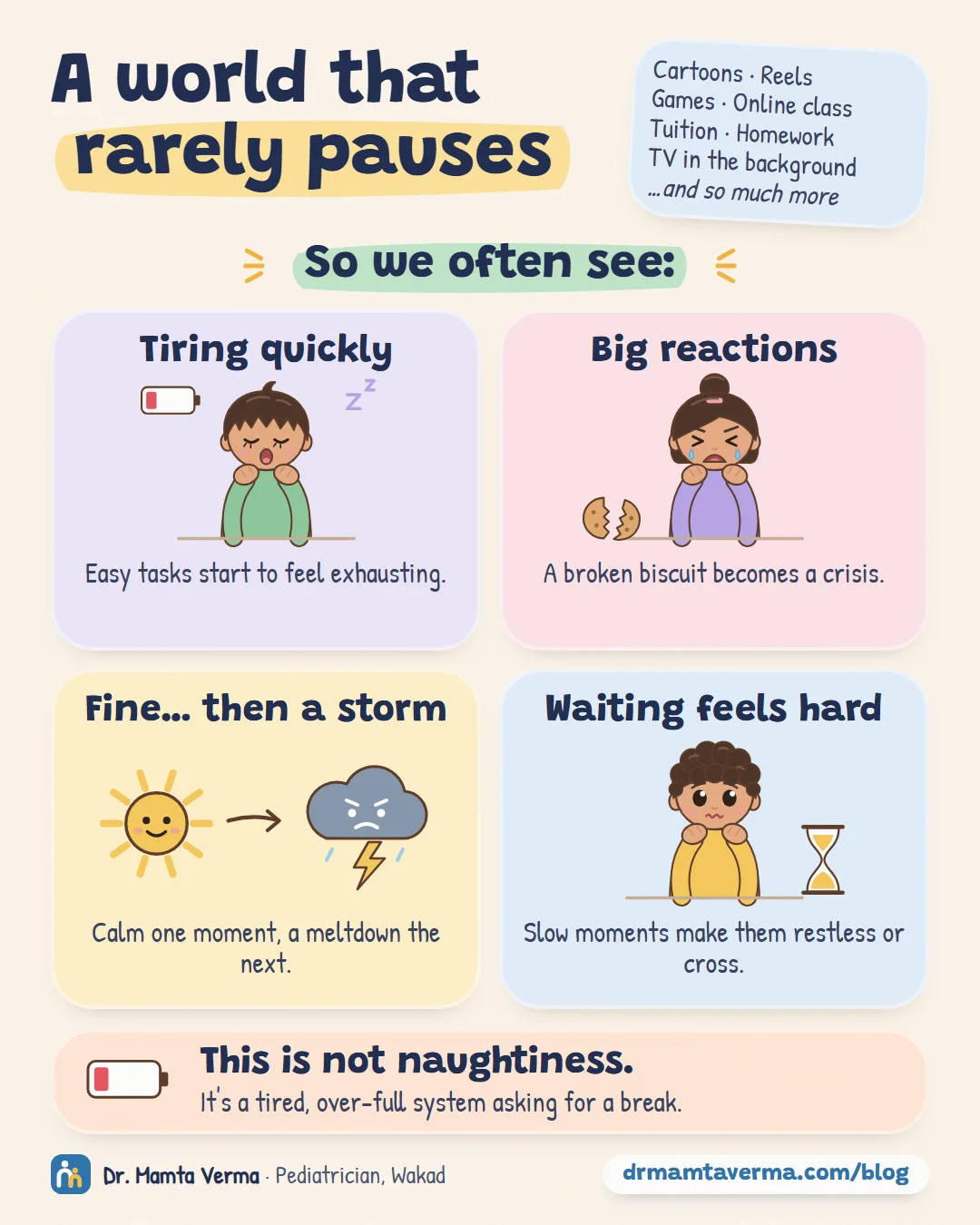
None of this means something is wrong with your child. Very often it is a tired, over-full system asking for a break. If these patterns are frequent, intense, or affecting sleep, school or friendships, please bring your child in. More on that below.
Big feelings, still-growing skills
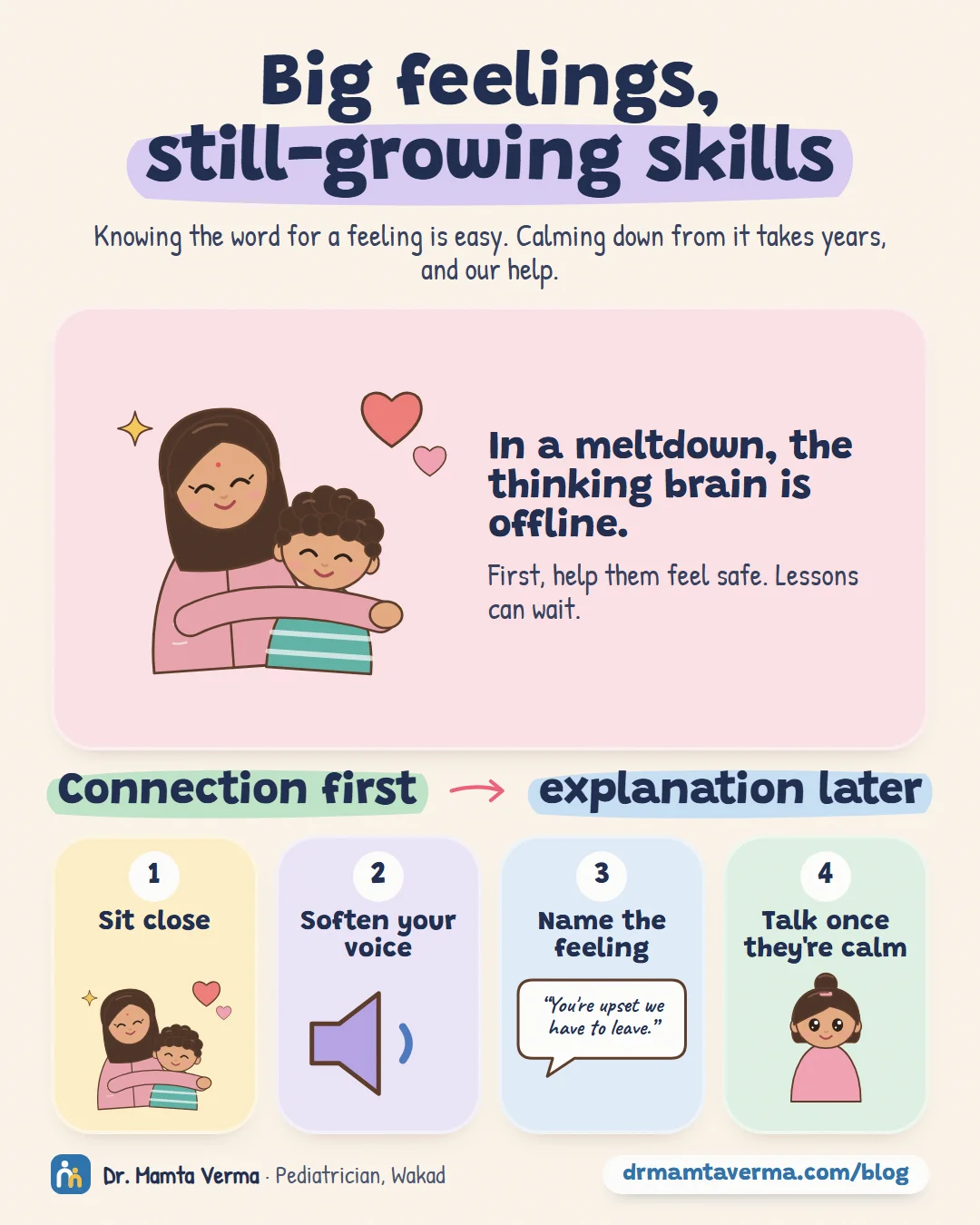
Many children today can tell you “I’m frustrated” or “I’m nervous”. That’s wonderful. But knowing the word for a feeling and knowing how to calm down from it are two different skills. The second one takes years to build, with a lot of help from the adults around them.
In the middle of a meltdown, the thinking part of the brain is not really available. That’s why explaining, lecturing or reasoning in that moment rarely works. First, your child needs to feel safe again.
Connection first. Explanation later.
Sit close, lower your voice, and name what you see: “You’re really upset that we have to leave the park.” Once they have settled, talk about what happened and what to do next time.
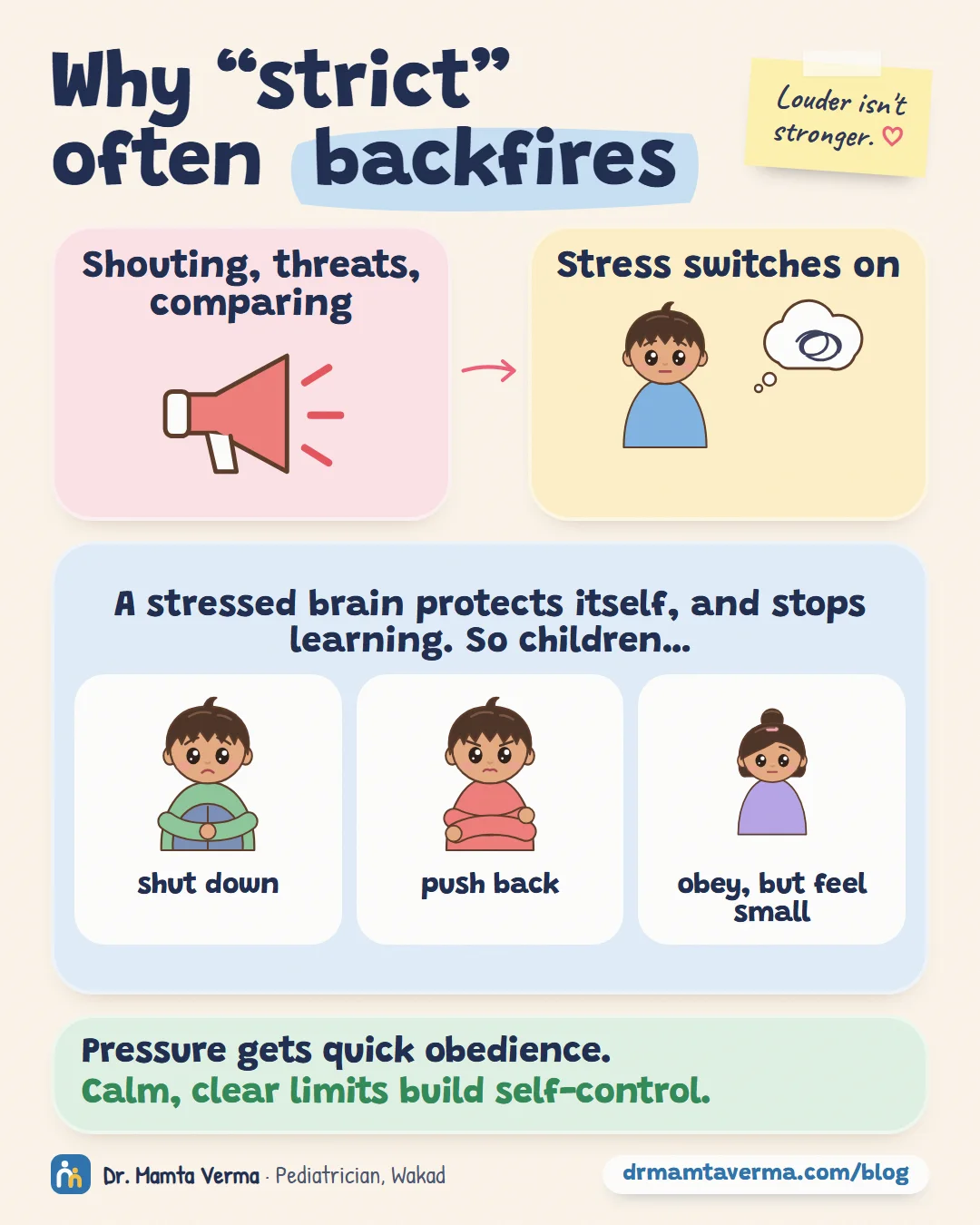
Why “being strict” often backfires
Many of us were raised on “Because I said so.” When we are exhausted, it is natural to reach for the same tools: shouting, threats, comparison, punishment.
The trouble is that fear and constant criticism keep a child’s stress response switched on. A stressed brain is busy protecting itself, not learning. So children usually react in one of three ways. They shut down, they push back harder, or they obey on the outside while feeling small on the inside.
Pressure may get quick obedience. It rarely builds confidence, honesty or self-control.
This doesn’t mean “no rules”. It means a different kind of authority: one your child can lean on, not one they are afraid of.
What actually helps
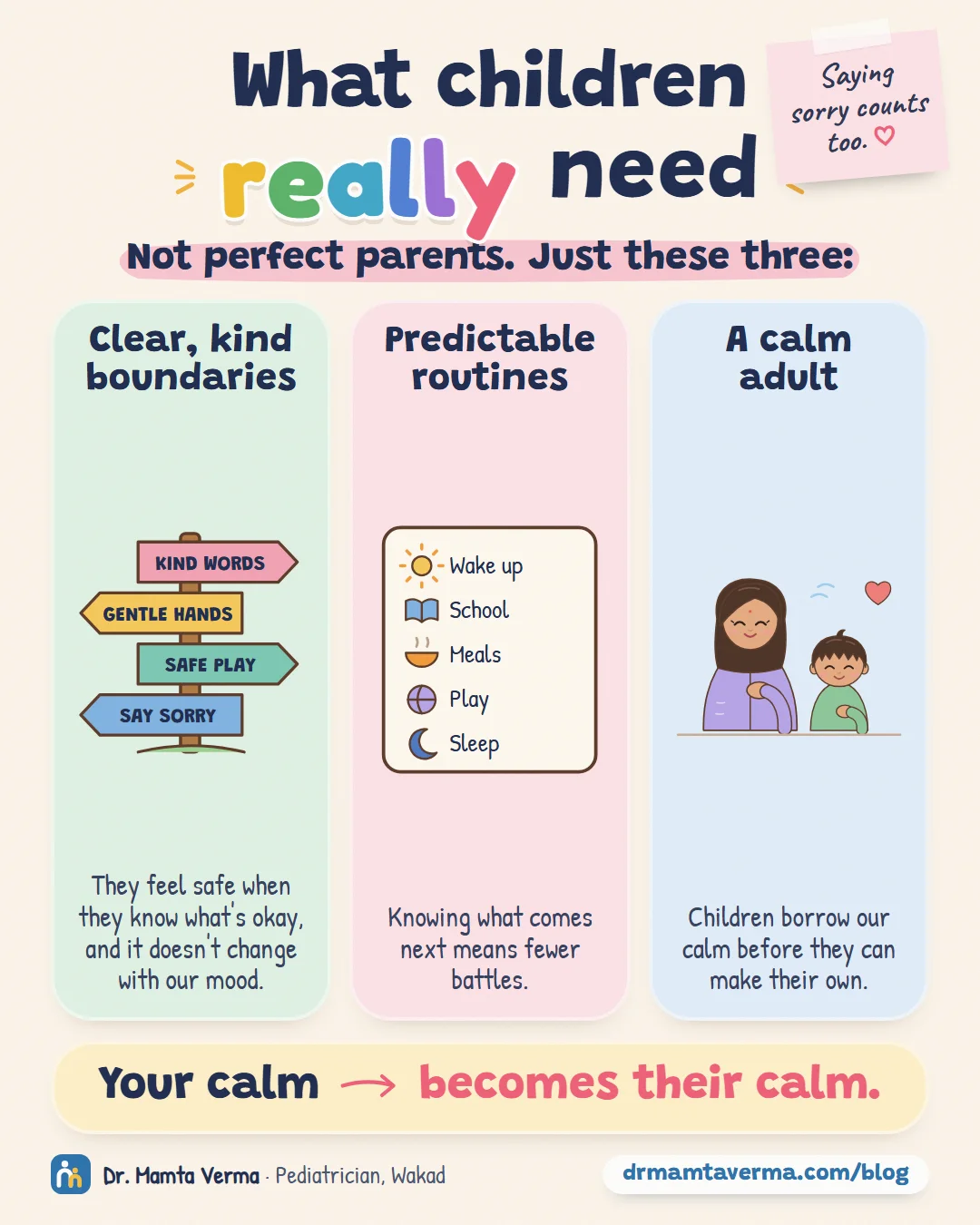
Children don’t need perfect parents. In my experience, three things make the biggest difference.
- Clear, kind boundaries. Children feel safer when they know what is okay and what isn’t, and that the answer won’t change with your mood. Keep rules few, simple and explained. “We don’t hit, because it hurts” works better than “Stop it!”
- Predictable routines. A steady rhythm for waking, meals, study, play and sleep means fewer battles in a day. When a child knows what comes next, there is less to fight about and less to worry about.
- A calm adult. This is the hardest one, and the most important. Children borrow our calm before they can make their own. When you stay steady, even when they can’t, they slowly learn how to settle themselves. You won’t manage it every time. Nobody does. Saying sorry afterwards (“I shouted. I’m sorry. Let’s try again.”) teaches them just as much.
| Instead of… | Try… |
|---|---|
| “Because I said so” | A short reason: “Helmet on, because heads are precious.” |
| Shouting across the room | Going to them, getting down to their level, lowering your voice |
| Comparing with siblings or classmates | Noticing their own effort: “You kept trying even when it was hard.” |
| Rules that change with your mood | A few rules that stay the same every day |
| Threats you won’t carry out | Calm consequences they can predict |
Screens aren’t the enemy, but the brain needs a break
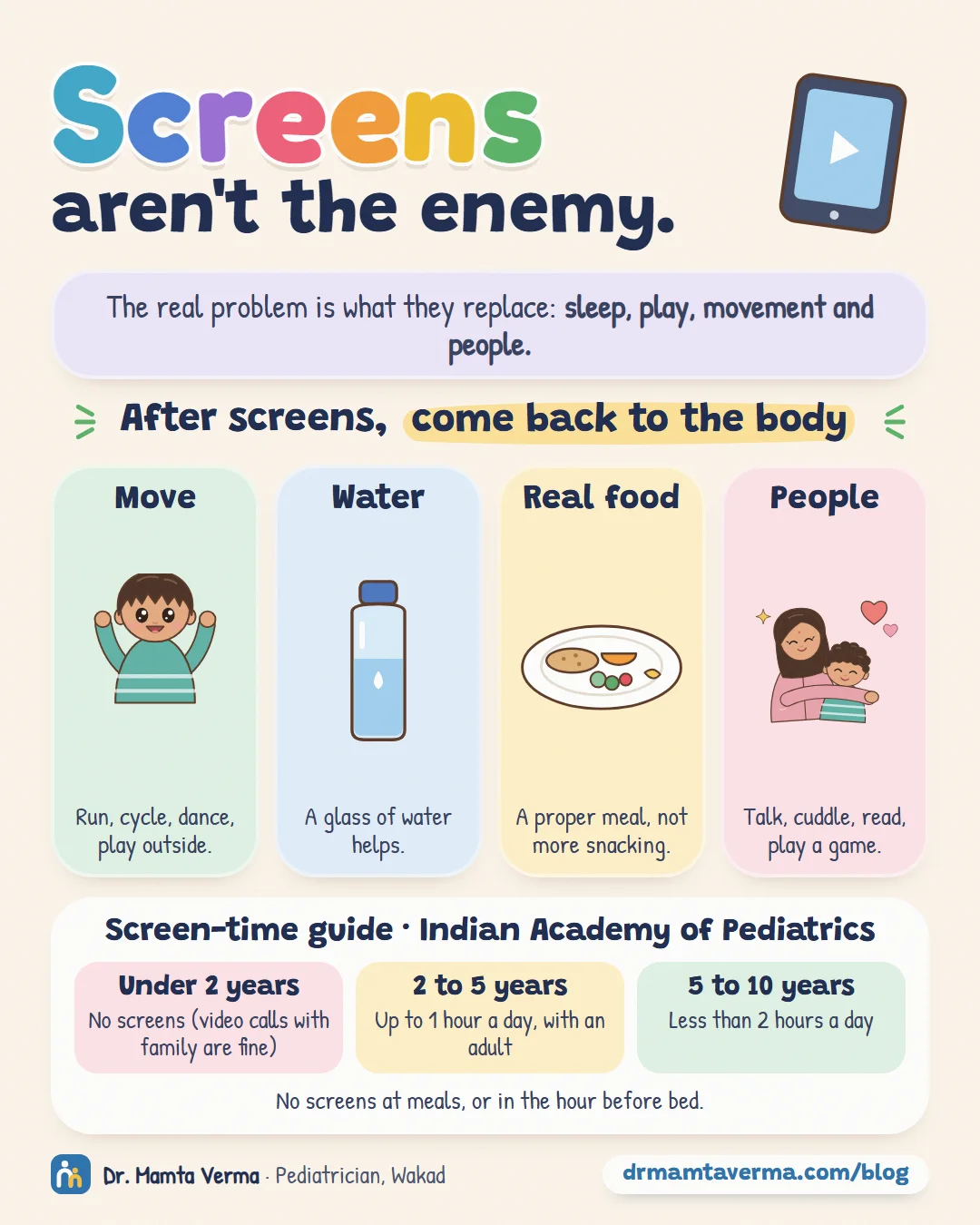
Parents often ask me if screens are “bad”. Screens can help with learning and creativity, and keep children in touch with family far away. The bigger problem is what they replace: sleep, movement, play and time with people.
After screen time, help your child come back to their body:
- Move. Run, cycle, dance, play outside.
- Drink water and eat well. A proper meal or a healthy snack, not more snacking in front of a screen.
- Connect. Talk, cuddle, read together, play a board game.
The Indian Academy of Pediatrics suggests no screens at all before age 2, apart from the odd video call with family. From 2 to 5 years, at most one hour a day, with an adult. From 5 to 10 years, less than two hours a day. Keep screens away from meals and out of the bedroom, and switch them off at least an hour before sleep.
Home should be a place to recharge
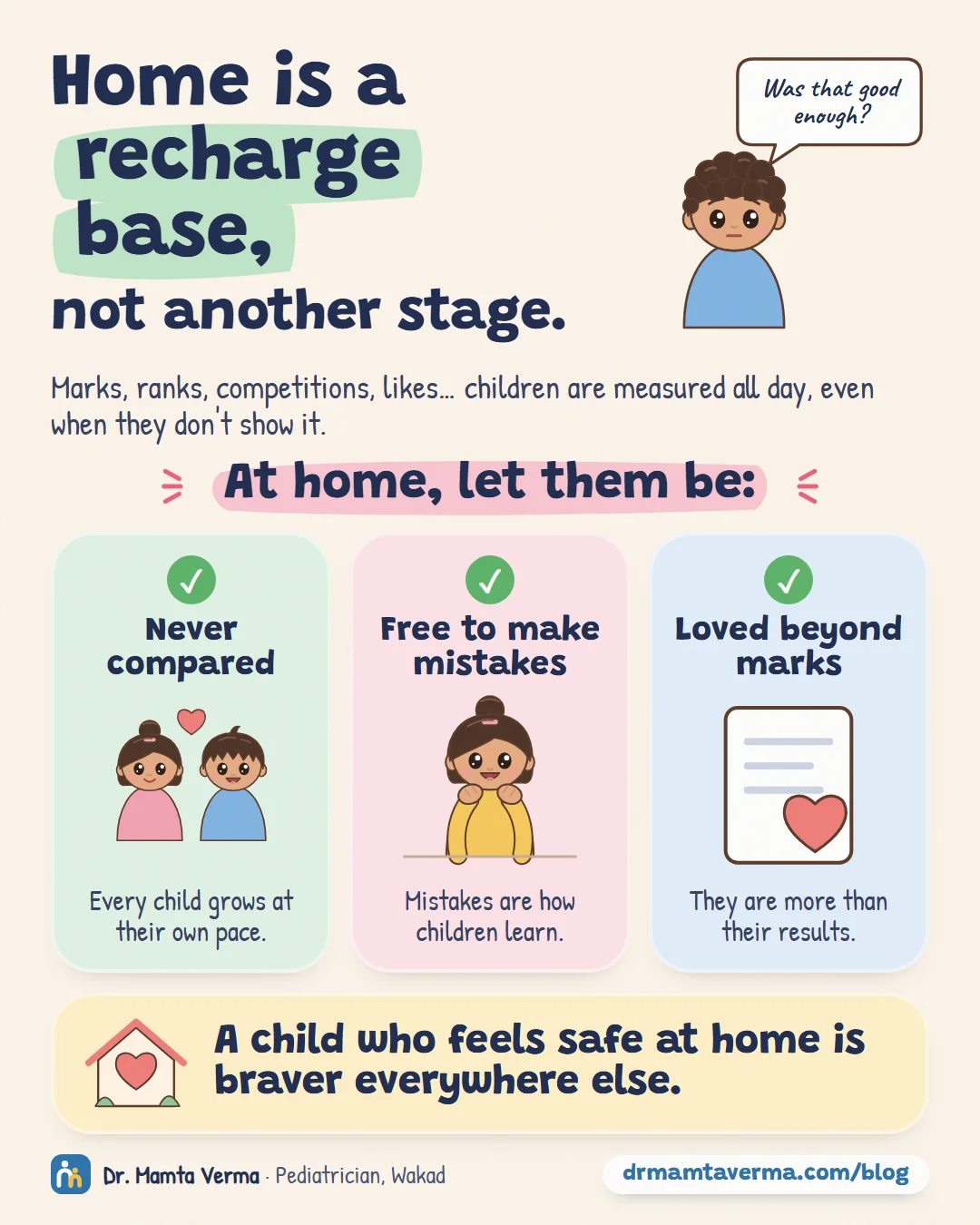
Children today are measured all the time: marks, ranks, competitions, likes. Even when they don’t say it, many are quietly asking themselves: Am I good enough? Will they be proud of me?
Home doesn’t need to be one more stage to perform on. It can be the place where your child:
- isn’t compared with anyone else,
- is allowed to make mistakes,
- is loved for who they are, not just for what they achieve.
A child who feels safe at home finds it easier to be brave everywhere else.
When to see a doctor
Most meltdowns and moody phases are a normal part of growing up. But please come and see me if you notice:
- outbursts that are very frequent, very intense, or getting worse,
- trouble with sleep, appetite or weight,
- a child who seems withdrawn, unusually anxious or sad for weeks,
- concerns from school about learning or behaviour,
- your child losing skills they used to have.
A check-up looks at the whole child: sleep, nutrition, growth and development, and what is happening at home and at school. If more help is needed, I will guide you to the right specialist.
The clinic in Wakad is walk-in, no appointment needed: Monday to Saturday, 10 am to 1 pm and 6 pm to 9 pm. For questions, call or WhatsApp 86689 93901.
In the end, it isn’t about being stricter or softer. It’s about understanding your child a little better, and staying steady while they learn.